Welcome to aka KikiWrites

I am one of those people who likes to watch, write about, and talk about old TV shows. So much so that I had to create an entire site just to contain that aspect of my existence.

aka KikiWrites is the official home of my podcast, Book ’em, Danno: An Old Hawaii Five-O podcast, which covers the 1968 Hawaii Five-O series. You’ll also find my guest spots on other podcasts, usually talking about old TV shows, but sometimes I do actually talk about other things, too. Rarely, but it’s been known to happen.

Since I’m a writer by nature, it’s only natural that I’d spare a few hundred thousand words on reruns. My Rerun Junkie posts cover shows, guest stars, characters, episodes, and context.

And if you happen to like the content, feel free to buy me a cup of coffee or two over on Ko-Fi.

So, settle in, find a channel, and enjoy.

Rerun Junkie Episode: “Bang, Bang, Your Debt”

Warning! Spoilers for CSI: Miami episodes 6-4, “Bang, Bang, Your Debt”; 3-1 “Lost Son”; 5-14 “No Man’s Land”; 5-15 “Man Down”; 6-15 “Ambush”; and 6-16 “All In”.
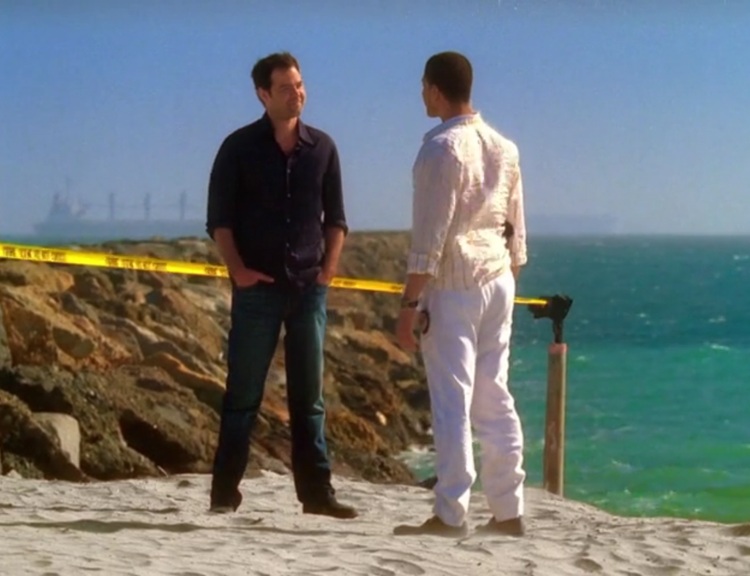
Rory Cochrane as Tim Speedle, a white man with dark hair, wearing a dark purple shirt and blue jeans, faces the camera, and Adam Rodriguez as Eric Delko, a latino man with short dark hair, wearing a light golden yellow striped shirt and white pants, faces away from the camera. They're standing on a beach with yellow crime scene taped stretched out behind them.I chose this episode for Shann for our Return of a Character episode of Here, Watch This. If you listen to that episode (and you should listen to that episode), you’ll hear Shann’s thoughts on it. But I want to give mine because I chose this episode for a reason.

This is probably one of my favorite episodes featuring the return of a character because it flows so well within the overall narrative arc of the show.

Now, I’ll be the first to tell you that CSI: Miami has its issues. I’m on record saying it’s bonkers. But, I adore it, even with its problems, and even with its problems, there are some things that it just gets right. Speedle’s return is one of them.

The episode finds the CSI crew investigating first the death of a coed and the near death of the not-boyfriend friend she was sleeping with, and then the connected shooting death of a credit card pusher. During the episode, Eric Delko sees and speaks with Tim Speedle.

There’s just one thing.

Speedle is dead.

Speed has been dead since the beginning of the third season. We all watched him get shot to death in a jewelry store (I really need to write about his death; it’s got some beautiful narrative symmetry, another thing the show got right), watched him bleed out all over the floor. But, Horatio’s brother came back from the dead, so maybe Speed did to. It wouldn’t be the first time the show took a page or six out of a daytime soap playbook.

What makes it possible is that while only Delko sees and interacts with Speed, there’s a moment in the episode where Calleigh finds Speed’s credit card in one of the hummers, and Delko does some investigating, leading to the discovery that there’s been activity on Speed’s credit card. There’s tangible evidence that Speed could be alive.

You spend the episode waiting. Speed can’t be alive, but a ghost isn’t going to be racking up charges on a credit card. What the hell does a ghost need with earthly goods and services? This doesn’t feel like a dream. Everything is too normal. Except for Speed.

The episode comes to a head when Horatio catches Delko going through Speed’s locker, finding that his wallet is missing. Delko is sure this is evidence that Speed is somehow alive, but Horatio -who was present at the shooting and watched Speed die- has a different suspicion.

With the help of a warrant, he gets the bank to give up the latest credit card transactions, which leads Calleigh and Delko to a bar. Delko thinks he sees Speed, but it’s someone who looks like him. That’s when Calleigh comes in with the big reveal: Cooper from the lab took Speed’s credit card and he’s been using it. Cooper’s credit card fraud ties in with the credit card debt theme of the rest of the episode and is later used as his motivation to be a dick that ultimately leads to Calleigh being kidnapped in a later two-part episode.

It’s a gut punch for Delko, who fully expected to find Speed in this bar. He truly believed his friend was alive.

Rory Cochrane as Tim Speedle, a white man with short, dark hair, wearing a dark purple shirt, backlit by a yellow orange sunset. He's smiling a little at the camera.As it turns out, Delko, who’d been shot in the head in the previous season and still has a bullet fragment in his brain, has been having transitory hallucinations due to his injury. It’s a bittersweet moment. Speed is gone, but he’s still so much a part of Delko’s life that when his brain decided to spark, it brought his fiend back from the dead.

The revelation and discussion between Delko and Horatio takes place at Speed’s grave. As Speed smiles and walks off into the distance, Delko says it feels like he’s saying goodbye all over again and Horatio admits that he sees Speed every day. It’s such a beautifully poignant scene that’s slightly unexpected in a show like this, though the show does have such moments on occasion throughout its run.

Speed’s return is so well done in the sense of how it flows into the narrative arc of the show. It’s not shoehorned in. There’s no great feats of gymnastics to make it plausible. You’re not required to suspend your disbelief beyond rational limits. It’s not a dream. It makes perfect sense.

And it gives me one of my heart achingly favorite moments in rerun TV.

Book ’em, Danno–Episode 81

Logo for Book 'em Danno: An Old Hawaii Five-O Podcast. Features the name of the podcast in white text outlined in red on the picture of a curling blue wave. Logo courtesy of Shann.

Season 7 has finally hit double digits! In Episode 9, “How to Steal a Masterpiece”, clever and classy thieves have Five-O searching for stolen art. We get to learn some fun things about art authentication, but I don’t go into detail in the discussion because everything I know I literally learned from an episode of another police show. Don’t tell me television can’t teach you anything.

And in Episode 10, “A Gun for McGarrett”, Steve finds his life on the line yet again. It’s been a while since Steve’s been blown up.

Listen on Soundcloud, Apple Podcast, and Spotify.

Steve canceled his sailing day for this.

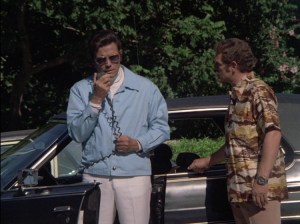
Steve, a middle aged white man with brown hair wearing a light blue jacket over a white shirt and pants and aviator sunglasses, and Danny, a young white man with curly blond hair wearing a brown, gold, and white aloha shirt and brown pants. They're standing next to a car and Steve is talking on a CB radio.

Book ’em, Danno–Episode 80

Logo for Book 'em Danno: An Old Hawaii Five-O Podcast. Features the name of the podcast in white text outlined in red on the picture of a curling blue wave. Logo courtesy of Shann.

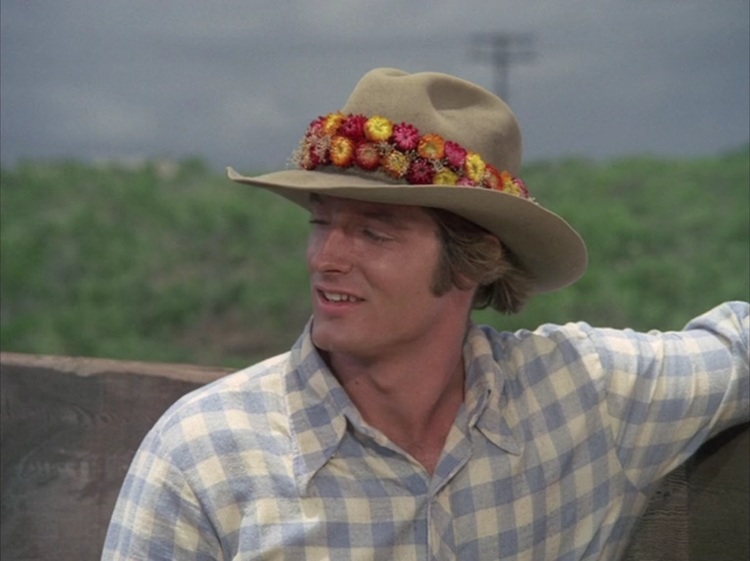
Five-O has to intervene to prevent some rich man justice in “We Hang Our Own”. The episode features Leslie Nielsen, the babiest of Bruce Boxleitners, and Perry King once again having an issue with his brother.

Then Five-O has to solve the murder of a man who wasn’t who he seemed in “The Two-Faced Corpse”. Jessica Walters being her usual fabulous self, Sam Elliott with no mustache, but some great lapels, and Abe Vigoda as an old mobster I would die for.

Listen on Soundcloud, Apple Podcasts, and Spotify.

Just look at those lapels.

Book ’em, Danno–Episode 79

Logo for Book 'em Danno: An Old Hawaii Five-O Podcast. Features the name of the podcast in white text outlined in red on the picture of a curling blue wave. Logo courtesy of Shann.

First Five-O deals with a senator under attack in “Bomb, Bomb, Who’s Got the Bomb?”. I’m issuing a trigger warning for mental illness for the episode. A couple of the scenes can be pretty upsetting.

Then Five-O has to solve the mystery of a dead bank robber and the missing loot in “Right Grave- Wrong Body”. Minor trigger warning for suicide if you’re watching the episode. It’s in spoiler territory, so I don’t discuss it.

Listen on Soundcloud, Apple Podcasts, and Spotify.

Steve sees the fantastic fashion in these episodes and he’s alarmed by the greatness.

I’ll Make You Pay for What I Did!

Drawing of an old school TV with antenna, a dark orange casing, brown legs, and a grey screen.This may be one of my favorite-for-the-wrong-reasons trope. It’s typically found in cop shows, but I’ve seen it in other genres as well.

The basic premise is simple. Someone who did a bad thing in the past has come back to seek revenge on the person who caught them doing the bad thing and/or got them in trouble for it.

A great example of this is the Simon & Simon episode “Double Play”. Rick and A.J. find themselves being framed and the list of suspects is just people they put in jail. None of these people are innocent; they all did what they served time for. Some of them hold grudges, some of them apparently don’t. But the person who framed them absolutely did it out of revenge.

Because they blamed Rick and A.J. for them going to jail.

I can’t count (well, I probably can, but I’m too lazy) the number of times someone rode into Dodge City on Gunsmoke looking for Matt Dillon because he put them in jail once and now they’re looking to get even. More than once did Steve McGarrett have to contend with a blast from the past coming back to exact revenge on Hawaii Five-O because he put them in prison for a crime they committed.

I think what I love the most about this trope is the absolute lack of self-reflection, the 100% denial to take any responsibility for their own actions that it depends upon. Sure, I made all of these dubious, unfortunate life choices, but you can’t honestly punish me for that, can you? How dare you! It’s hilarious. It’s an adult version of a temper tantrum. I was held responsible for my actions. I’ll show you!

I would love to say that it’s an unrealistic trope, but unfortunately, lower stake versions of this sort of thing happens all the time. People will do gymnastics that rival Simone Biles to avoid taking responsibility for their own actions, gladly trying to stick the landing of blaming the person who called them out. Amazing.

I’ve seen one good twist on this trope in an episode of Barney Miller called “The Vandal”. The detectives of the 12th Precinct arrive to find that their squad room has been vandalized, including graffiti specifically calling Barney an unmentionable name. While there’s plenty of speculation of who the culprit is, it turns out to be a man from Barney’s past seeking vengeance for the ticket Barney gave him for littering decades before, an incident that Barney can’t even remember.

The twist comes from the fact that the man isn’t necessarily seeking vengeance for being held responsible for his “crime”, but that because Barney insisted on holding him up to write such a petty ticket, the man missed his job interview which led to his life descending in a downward spiral.

One can argue that if the man hadn’t littered in the first place, he never would have gotten the ticket, but it also shows that Barney wasn’t always the compassionate, understanding leader that we had by that time come to know. It also illustrated how something that can be insignificant for one person, can be monumental for another.

However, this is a rare instance. Most of these people are going to continue to make our heroes pay for catching them.

And I’m going to enjoy every minute of it for all the wrong reasons.

Book ’em, Danno–Episode 78

Logo for Book 'em Danno: An Old Hawaii Five-O Podcast. Features the name of the podcast in white text outlined in red on the picture of a curling blue wave. Logo courtesy of Shann.

Season 7 is still fresh and new and already leaning into the wild.

First, Five-O contends with a clever killer recreating solved murders in “I’ll Kill ’em Again”. I’m issuing a minor trigger warning for suicide if you watch the episode. I don’t mention it in the discussion.

Then Steve and his team take on a deadly fencing operation in “Pay Now- Steal Later”. It’s Casey Kasem in some incredible sport jackets and Ray Danton shirtless. The best of all worlds.

I apologize for the cicadas. They were particularly vocal during the second episode discussion.

Listen on Soundcloud, Apple Podcasts, and Spotify.

A variety of gentlemen in this episode.

Those Weak and Wily Women of the Wild West

Silhouette of a cowboy on horseback leading another horse against a pink, orange, and blue sunset. Image by Yuri from Pixabay.I am by no means an expert on TV Westerns. (Actually, you could put “I am by no means an expert” on my headstone because I’m not an expert on anything; I’m just really good at running my mouth.) But I have watched all of The Big Valley and Bonanza, and just about every episode of Gunsmoke thanks to my father’s latest binge watching habits, and I’ve noticed something.


Women in the old west were pretty weak. The plot typically calls for them to be at the mercy of something, usually a man. The man is either a bad man who makes everyone miserable or a man she loves who is either a bad man who makes everyone miserable or a good man who makes terrible life choices.

I honestly think the latter makes my eye twitch more.

There’s this insinuation that all a woman wants is to have a man and that she will put up with anything to have one, even if that man is garbage. The number of times I’ve heard, “You have to do X because I am your husband,” or “because you love me” or “because you don’t have a choice.” I would be a widow. Men outnumber women in the Old West. I will find me a new one that does not try my nerves to such an extent.

Which brings me to my next observation.

Men did outnumber women back in the Old West because it was a rough life. It wasn’t for everyone. You had to be pretty tough to survive out there. So, it stands to reason that most of the women out there would be a little more involved in self-preservation. They probably wouldn’t be as tolerant of their man’s bullshit because finding another one would pose no challenge.

Also, women would have to be tougher to survive out there, period. Depending on a man wouldn’t be the best strategy because if your man is shit or if he dies -which was probably pretty likely, especially in a TV Western- a woman would be shit out of luck. And that has been the plot of more than one of these episodes. The women are always looking for a man to save them.

I find this most egregious when it comes to the saloon girls working at the Long Branch on Gunsmoke. We all know what their business really is -wink wink nudge nudge- and the fact is that in order to survive that lifestyle, you had to be a helluva lot tougher than the men. Looking for a fella to save you wasn’t going to work out in your favor and being pushed around by the clientele was bad for business. Miss Kitty was a bad ass broad, but I feel like she should have shot a lot more men.

Which brings me to the flip side. Sort of.

If the women weren’t weak, they were wily. They were plotting, cunning, and conniving, using their feminine wiles to get what they wanted. It frequently manifests as a woman pitting two men against each other, or using a man as a proxy to enact either vengeance or self-enrichment. These women are tough, in their way, and that’s a bad thing. Being tough and resilient is at odds with femininity, at least in the minds of cowboys and the men who wrote them.

Of course, there are exceptions. Miss Kitty and Victoria Barkley are notable in this respect. Both women are fiery, independent, and not apt to take shit from any man. Victoria Barkley was skilled with a whip and even though I thought Miss Kitty should have shot more men, that didn’t mean she didn’t have a gun behind the bar and that she didn’t use it. I also saw her whip a man with a parasol once. I wouldn’t cross either one of those women.

I suppose they didn’t want independent, strong women to have too much representation in the Old West.

The ladies might get ideas.

Book ’em, Danno–Episode 77

Logo for Book 'em Danno: An Old Hawaii Five-O Podcast. Features the name of the podcast in white text outlined in red on the picture of a curling blue wave. Logo courtesy of Shann.

Season 7 of Hawaii Five-O and Book ’em, Danno has arrived!

We’re officially on the back half of the series, which is pretty exciting considering I wasn’t sure if I’d be able to stick with it for more than a couple of seasons. Now here we are.

The new season kicks off with a radical group committing mayhem in “The Young Assassins”, and extortion via volcanic eruption in “A Hawaiian Nightmare”. Also my periodic reminders.

I’d made the decision to make the episodes shorter going forward beginning with this season. I failed right out of the gate.

So, enjoy my extra long rambling on Soundcloud, Apple Podcasts, and Spotify.

Let’s have some fun!

Even a shady Sheree North can’t believe what baby Larry Wilcox is getting up to.

That Pesky Due Process

A pair of silver handcuffs on a black background. Image by jp from Pixabay.It’s a common trope on a cop show.

The good guys have caught the bad guy, but the bad guy gets off on a technicality. The good guys are then forced to watch their bad guy walk free to create more of their brand of mayhem, usually while giving an impassioned version of “I’m going to nail that guy if it’s the last thing I do,” a lyric that fits into almost any melody a fictional super cop wants to sing.

Naturally, since we’re on the side of our good guys, we’re incensed with them. The justice system is clearly flawed/broken if it would allow a bad guy to walk free, a bad guy that we know is a bad guy because our good guys said so. We’re confident that our cops will see that justice is done no matter what those fancy attorneys and incompetent judges do. And, of course, they do. Just as we knew they would.

It’s a clever trick of copaganda.

“Technicality”. It makes it sound like someone didn’t dot an I or cross a T. And while it is accurate -the defendant wasn’t found not guilty, they were released because of a technical error- it’s also deceptive. The shows tend to gloss over how these “technicalities” are part of due process.

Due process is that pesky part of the Constitution that guarantees a person is granted certain rights and protections when dealing with the legal system. These are guaranteed rights that apply to everyone, not just citizens, not just the innocent. Due process covers such things as habeas corpus, the right to remain silent, the right to counsel, the right to cross examine a witness, the right to a speedy trial, the right to access to the evidence, etc.

Cop shows love to make defense attorneys look morally questionable. After all, they’re defending the bad guys. They also love to make them look sneaky when they use these “technicality tricks”. While they gloss over the nature of the technicalities, they also gloss over the role of the defense attorney. Their job is to defend their client. Part of that defense is to make sure that their client’s rights aren’t being violated.

An episode of Hawaii Five-O deals with the consequences of due process in an interesting way.

In the sixth season episode “Mother’s Deadly Helper”, an accused man has his case dismissed because the prosecution can’t produce a needed witness to proceed with their case. The defense attorney asks for a dismissal based on the fact that the repeated continuations that the state’s attorney has asked for violates his client’s right to a speedy trial.

It feels like a miscarriage of justice because we learn later that this guy is a hitman. But it’s not because even hitmen are entitled to their rights.

His freedom is short-lived as a vigilante snipes him as soon as he leaves the courthouse. The disgruntled citizen in this episode is fed up with “soft-hearted judges” letting criminal walk. The “soft-hearted judges” in question are committing the unforgivable acts of upholding the rights of individuals.

In the context of cop shows, it feels egregious to allow these bad guys the same rights as the innocent folks because what we want to see is our good guys putting them behind bars for good.

I suppose it feels egregious in the context of the real world, too. Especially when it seems like those rights favor a select group of the population.

But we all have them.

Even fictional bad guys.

Wasn’t That Guy Already On This Show?

Drawing of an old school TV with antenna, a dark orange casing, brown legs, and a grey screen.I was scrolling through Instagram one day, afflicted by the way it insists on showing me posts from people I do not follow, when I happened across a video in which a young person was questioning a TV show’s choice of using an actor that had already guest starred on the show once to guest star again in a different role. They went so far as to question whether or not the casting department should keep a list so things like this don’t happen.

And I thought, “You sweet summer child. You absolute infant. Let me show you the history.”

Because this was the rule not the exception back in the long, long ago, and even the not-so-long ago, and I had no idea (thanks to my lack of watching many current shows) that it has become something not as common in the present tense.

My first thought upon seeing this video, the first example that popped into my mind was Gunsmoke. It was the source of employment for many actors in the course of its 20 years on the air, and had frequent repeat guest stars who showed up in multiple episodes and never played the same character twice.

My dad is currently binge watching this series, so it feels like every time I come into the room, Victor French (18 episodes), Morgan Woodward (19 episodes), Jack Elam (15 episodes), Denver Pyle (14 episodes), John Dehner (12 episodes), and John Anderson (12 episodes) are on. I’m not complaining. I love them all. But binge watching makes it obvious just how much they were on and how many of those episodes were in the same season.

It was commonplace, particularly in long running shows, to have those kinds of repeats. In the case of Hawaii Five-O and Magnum P.I., the location made it necessary to use a lot of the local talent multiple times. Not only are they showing off the unique and diverse culture of Hawai’i, but also, not everyone could be flown in from the mainland.

When you find a good actor, you want to keep them around. Jack Webb had a sort of stable of actors that he would draw from. Tim Donnelly and Marco Lopez, for example, appeared in multiple episodes of both Dragnet and Adam-12. And those guest spots scored both men a regular gig on Emergency!

Which brings me to the next recurring guest star practice that might blow this questioning young person’s mind.

Guest starring is how some actors found their regular gig. Both Ken Curtis and Buck Taylor appeared as different characters on Gunsmoke before landing their regular roles of Festus and Newly, respectively. Harry Morgan appeared as a general before being cast as Colonel Potter on M*A*S*H.

And sometimes you get the flip side of that.

An actor that had been a recurring character coming back later as a different character. On The Monkees, Henry Cordon spent the first season playing the band’s landlord in several episodes before coming back as a completely different character (in another location even!) in the second season. John Orchard was Captain “Ugly John” Black in the first season of M*A*S*H before coming back much later in the 8th season as a completely different character for an episode.

And even though I can’t think of an example off the top of my head (because I’m too lazy to do actual in-depth research), I’m positive I’ve come across instances in which an actor played a recurring character, guested as a different character in an episode, and then resumed their recurring role. Drop me a comment if you think of one.

I suppose what I’m getting at is that this is the nature of the business and our part is to suspend our disbelief and pretend that Ed Flanders is a different guy every time he decides to take on Steve McGarrett.

Let’s have some fun.